
Lonestar Plumber in The Colony
Plumbing Leak Detection Corinth, TX
Plumbing leak detection in Corinth works by elimination: the meter, pressure gauges and valves narrow the loss to one line before any drywall, tile or concrete is touched. The spot is marked, you hear what probably failed, and no surface is opened before you have approved the repair and its price.
Corinth homes and plumbing leak detection
Two city tools help before anyone arrives. Corinth's Know Your H2O portal shows your water use, updated several times a day, and can send leak alerts when use crosses a threshold you set; customers enrolled in online bill pay are signed up already. Use that keeps ticking through the night, with every fixture idle, is the classic sign of a leak, and a screenshot of that graph is worth having when you call. If an alert arrives, shut off the irrigation controller and every fixture, then read the meter twice, an hour apart. A change between the two readings with nothing running confirms the loss before anyone is booked.
Timing matters as well. The city sets the coming year's sewer charge from what the household uses November through February, dropping the highest month and averaging the other three, and the result applies for twelve months from April. A hidden leak running all winter therefore costs twice: once on the water bill and again across a year of sewer charges. Finding it before the window closes is the cheaper path.
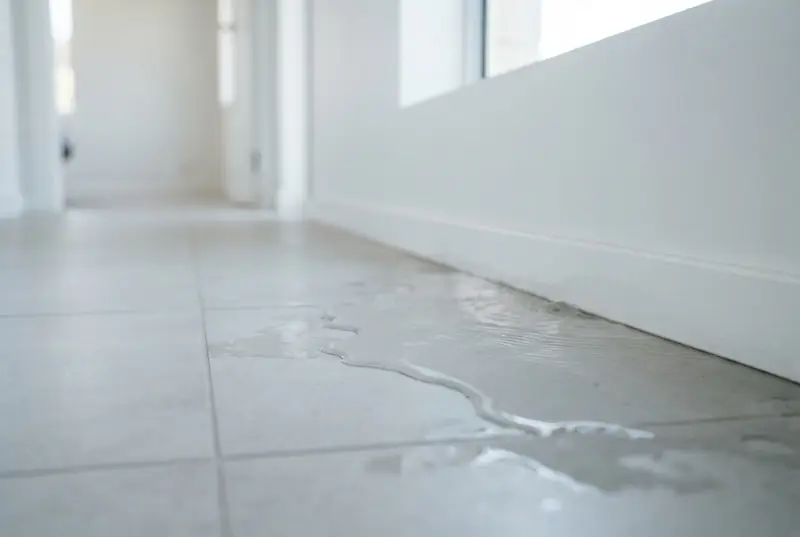
Location decides who pays. The meter and its box belong to the city; the private service line is the owner's, even where it runs through the public right-of-way, and the city cannot spend public funds on it. Under the house, most homes here date from the 1990s, with supply pipe in or below the slab, so a floor that feels warm underfoot, or a meter dial that never rests, is often the only clue. That holds whether the slab was poured three decades ago or in Walton Ridge within the last year. A hot-water line leaking under tile often gives itself away as a warm spot; a cold-water line rarely does, so on the cold side the gauges and the listening gear carry more of the search.
Corinth at a glance
- County
- Denton County
- Typical home
- Median year built 1997
- Water supply
- City of Corinth, buying treated water from Upper Trinity (UTRWD)
- Permit office
- Building Services, City Hall, 3300 Corinth Pkwy., (940) 498-3207
- Permit portal
- Civic Access portal (replaced eTrakit in March 2025)
- From our office
- About 19 miles from our Main St office in The Colony, mostly by I-35E
Signs water is escaping out of sight
- The meter's low-flow indicator spins with all taps closed
- A water bill that jumps with no change in use
- A warm patch on a tile or wood floor
- Running water heard in a wall when nothing is on
- A ceiling stain, soft drywall or musty smell that keeps returning
Questions from Corinth
My Know Your H2O graph never drops to zero. Is that a leak?
Very likely, if nothing is meant to be running. Rule out the usual suspects first: a toilet that refills by itself, an ice maker, a softener regenerating, the sprinklers. With those off, check the meter. A leak indicator that keeps spinning means water is escaping somewhere, and detection finds where without opening walls on a guess.
Could the leak be in my sprinkler system?
Often. Turn off the irrigation controller and the system's own shutoff, then watch the meter again; a dial that goes still points to the sprinkler side. Where a backflow assembly is fitted, Corinth wants it tested at installation and no less than once a year from then on, and that test is a good moment to catch a weeping valve.
Can I test for a hidden leak on my own?
Yes. Turn off every fixture, the ice maker and sprinklers included, and watch the leak indicator on the water meter. If it turns, shut the valve where the main enters the house. A dial that then goes still puts the leak inside; one that keeps moving puts it underground, on the meter's side of that valve.
Booking in Corinth
Call (469) 940-4415 to book leak detection. Take a meter reading first and note any spot that is wet, warm or stained. If water is visibly running, close the main shut-off. Have a recent water bill handy if the bill was your first clue.