
Dallas–Fort Worth
Whole-Home Repiping in Dallas–Fort Worth
When a pipe system starts failing in more than one place, patching buys weeks. A repipe replaces every water supply line in the house and ends the cycle.
- A price before any work starts
- Your approval before we begin
- Tested before we go
What you should know
Pipe wears out as a system, not one joint at a time. Copper under a slab pits until it pinholes. Polybutylene grows brittle with age and fails where pipe meets fitting. Galvanized steel chokes on its own rust. The first leak is a repair. The third is a pattern.
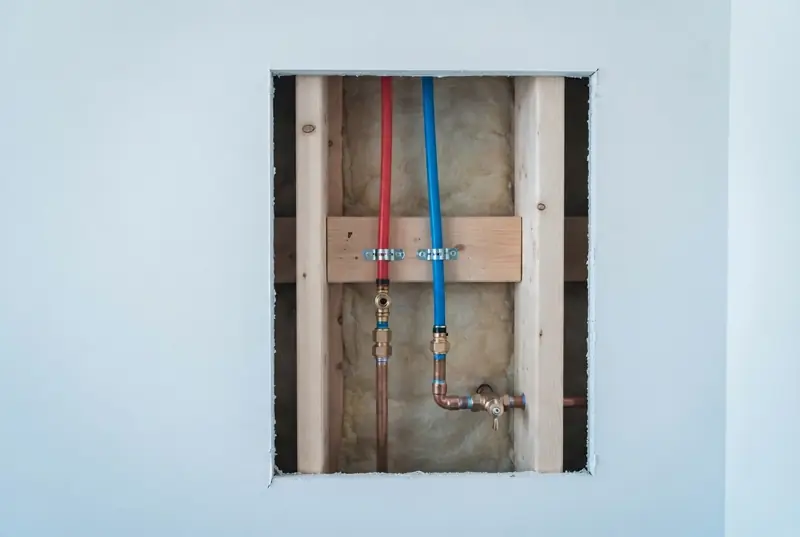
In a repipe the old supply lines are taken out of service and replaced with new pipe, PEX in most cases, routed through the attic and walls to every fixture. The slab stays closed. Drywall is opened at planned points instead of wherever the next leak happens to appear. Before work starts you will know the route, the number of openings and what the price covers.
Signs it is time to stop patching
- Leaks that keep coming: a second or third in a short span
- Gray plastic supply pipe, often stamped PB2110
- Threaded steel pipe, and rust-tinted water when a tap first opens
- A shower that weakens whenever someone opens another tap
- A repeat slab leak on the same run of pipe
Process
The job, step by step
Survey
We identify the pipe material, map every fixture and check the attic and wall paths.
Plan and price
You get the route, the opening locations and the price before anything starts.
Run new lines
New pipe goes in section by section. Fixtures are switched to the new lines one at a time, and the old pipe is capped off.
Test and close
Before any wall is closed, the new lines sit under test pressure and, where the city requires it, pass inspection.
Local context
The North Texas factor
North Texas has more repipe candidates than most regions, for a simple reason: the region's growth spurt between the late 1970s and the mid-1990s lines up with the polybutylene years. Add slab foundations, where reaching a pipe under the floor takes a jackhammer or a tunnel, and running new lines overhead becomes the practical answer. Overhead lines need protection, though. In the February 2021 freeze, many of the pipes that burst were uninsulated runs in attics and exterior walls. New lines should be insulated and kept low, under the attic insulation where possible.
Questions
Repiping questions, answered
PEX or copper?
Most repipes here use PEX. It snakes around obstacles with far fewer joints, and it has some give when water freezes inside it, which rigid pipe does not. It is still not freeze-proof. Copper is still a good material and suits some homes. We recommend one for your house and explain why.
Do you have to tear out my walls?
No. A repipe needs access openings at fixtures and along the route, not whole walls. The count depends on the layout of the house. You will know the number and the locations before work starts, and whether the price covers patching.
Does a repipe include the drains?
No. Repiping covers the pressurized supply lines, hot and cold. Drain and sewer lines are a separate system with separate problems. If your home has cast iron drains, a camera inspection will show what condition they are in.
Service area