
Dallas–Fort Worth
Water Heater Repair & Replacement in Dallas–Fort Worth
Cold showers, hot water that runs short, or a tank sitting in a wet pan. We find the cause, price your options and let you decide.
- A price before any work starts
- Your approval before we begin
- Tested before we go
What you should know
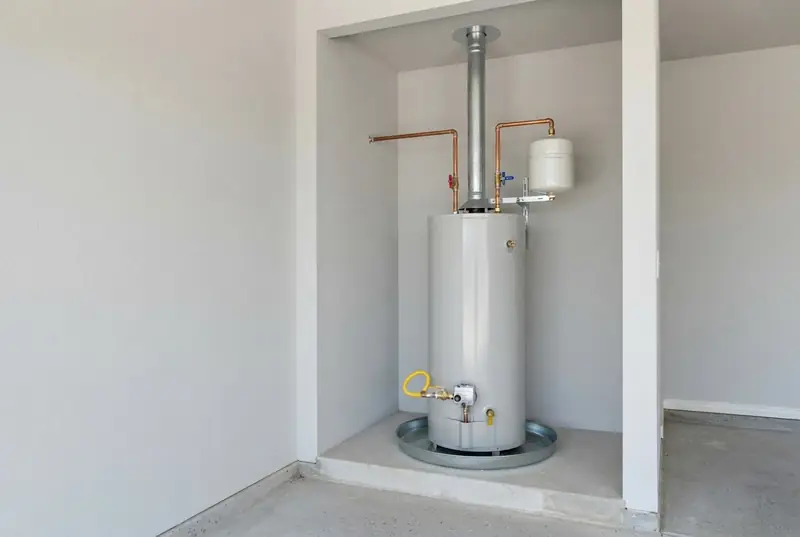
Strip away the jacket and a water heater is not complicated. There is a steel tank, a heat source (a gas burner or two electric elements), a thermostat and a short list of safety devices. Most failures in the early years are parts: the igniter, the thermocouple, the gas control or a heating element. Those are repairs. A tank that leaks from its body is finished, and no part fixes it.
Tank units typically last eight to twelve years here. Tankless units can run much longer, but only if the scale is flushed out on schedule. If the unit has to be replaced, judge the job by the installation as well as the heater: correct venting, a drain pan that actually drains, a working relief line, an expansion tank where the system needs one and a gas line sized for the burner.
Signs a water heater is in trouble
- Showers that turn lukewarm earlier than they did last year
- A tank that pops or knocks like a kettle while it heats
- Water in the pan, or a drip from the relief line
- A pilot that goes out repeatedly, or a breaker that will not stay set
- A tankless unit that shuts off mid-shower or shows an error code
Process
The job, step by step
Find the fault
Gas or electric supply, igniter or elements, thermostat, vent and tank are each checked. The rating plate gives the age of the unit.
Give you the numbers
A repair price, a replacement price where both are reasonable, and a plain recommendation.
Do the work
Repairs get the correct part for the unit. Replacements are installed to current code, with the permit your city requires.
Test and clear out
We fire the unit, check every gas and water connection, confirm the temperature and remove the old tank.
Local context
The North Texas factor
Hard water is the main reason water heaters die young in North Texas. Minerals settle on the bottom of a tank, insulate the water from the burner and cause the popping you hear. In a tankless unit the same minerals plate the heat exchanger until the unit overheats and shuts down. A lot of local houses also keep the heater in the attic, and a tank that fails up there empties into the ceiling. For an attic unit, the pan, the pan drain and the age of the tank deserve a look once a year. A replacement needs a city permit almost everywhere in the Metroplex.
Questions
Water Heaters questions, answered
How do I know when a water heater is past repairing?
Two things settle it: the tank and the calendar. A tank that leaks from its body cannot be repaired. A dry, solid tank that is less than about eight years old generally deserves the repair. Once a unit is past ten or twelve, money spent on parts is money that could have gone toward its replacement. Between those ages you get both prices and decide.
What does switching to tankless involve?
More than swapping the box. A gas tankless unit burns far more fuel while it runs than a tank does, so the gas line often has to be upsized. It needs its own venting and, in hard water, descaling on a schedule. In return you get hot water that does not run out, and floor space back. Whether it suits your house depends on the gas meter, the pipe run and where the vent can go, so those get checked first.
Why does a new tank need an expansion tank?
Water expands when it is heated. A pressure-reducing valve or a backflow device at the meter turns the house into a closed system, so the extra volume has no way out and pressure jumps on every heating cycle. An expansion tank absorbs it. Plumbing code calls for expansion control on a closed system, and city inspectors here look for it.
Service area